SHEET 01 · LLM SYSTEMS
Your Prompts Are Technical Debt: A Migration Framework for Production LLM Systems
Your prompts aren't instructions. They're contracts with an expiration date.
PLATE · 55s explainer · Captioned, music only
Contents
- The Ground Never Stops Moving
- What's Missing from the Industry's Response
- A Migration Framework That Actually Works
- Layer 1: The Abstraction Layer
- Layer 2: The Regression Harness
- Layer 3: Prompt Versioning and Lifecycle Management
- Layer 4: Canary Rollouts
- The Framework in Practice: Replaying the Healthcare Disaster
- The Bigger Picture
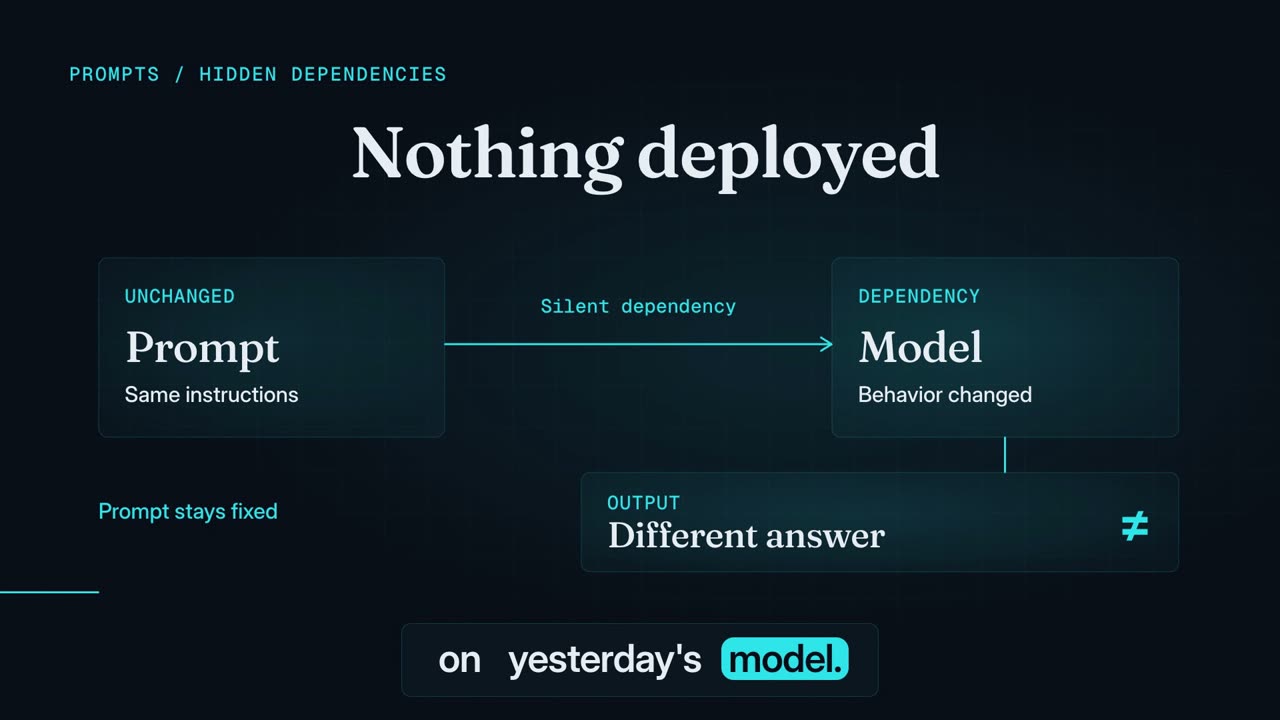
- A prompt in production isn't an instruction. It's a contract with a specific model version, and when the model changes, the contract is silently voided even though the words never moved.
- Model migration failures are semantic, not syntactic: a 200 status code, a fast response, and a confident, well-formatted, subtly wrong answer. Your monitoring never sees it.
- The fix is a four-layer framework, an abstraction layer, a regression harness, prompt versioning, and canary rollouts, all in place before the deprecation notice arrives.
- Done right, this turns model migration from a recurring emergency into a routine operation, and a compounding competitive advantage.
Last October, I watched a team of senior engineers spend three weeks debugging a production system that hadn't changed. No new deployments. No infrastructure modifications. No code commits. The root cause? Their model provider had silently updated the model version behind a stable API endpoint. The prompts that had been painstakingly refined over months, prompts that drove a revenue-critical workflow, started producing subtly different outputs. Not wrong enough to trigger error monitoring. Not right enough to trust.
They didn't have a model migration problem. They had a prompt infrastructure problem. And if you're running LLMs in production today, so do you.
The core issue is a mental model problem that most teams haven't confronted yet. We think of a prompt as an instruction, a static string that tells the model what to do. But a prompt in production is actually a contract, a set of assumptions about how a specific model version interprets language, structures output, handles ambiguity, and manages edge cases. When the model changes, the contract is voided, even if the words in the prompt haven't moved.
This is technical debt in its purest form. It accrues invisibly, it compounds with every model release you defer, and it comes due all at once when a deprecation notice lands in your inbox.
SHEET 02 · ESSAY SECTION
The Ground Never Stops Moving
To understand why this matters now, look at the cadence of change. In the first half of 2025 alone, there were twelve or more major model releases across the frontier providers. OpenAI's GPT-5 line iterated through five distinct versions by early 2026. Anthropic deprecated Claude 3.5 Sonnet in August 2025 with roughly two months' warning. OpenAI deprecated all legacy ChatGPT models when launching GPT-5, initially giving users zero transition time before reversing course after backlash. Google blocked new access to Gemini 2.0 Flash for new projects as of March 2026, pointing everyone to 2.5 Flash or later.
Each of these events forces a response. And the response is never as simple as changing a model string in an API call, because the failures aren't syntactic. They're semantic. Your API returns a 200 status code. Your monitoring sees a successful request completed in 1.2 seconds. What it doesn't see is that the model silently changed how it structures a JSON response, or started hedging on answers it used to give directly, or began interpreting "concise" as "three paragraphs" instead of "three sentences."
Two cases made this painfully concrete for me.
The Tursio enterprise search team (documented in their migration case study on Medium) had meticulously stabilized their prompt suite against GPT-4-32k. When they tested those same prompts against GPT-4.1 and GPT-4.5-preview, only 95.1% and 97.3% of their regression tests passed. That sounds close to fine. It is not fine. At ten thousand queries a day, that's five hundred silent failures: different output formatting, altered interpretation of ambiguous instructions, shifted reasoning strategies. These "soft failures" are more dangerous than hard errors because they degrade user trust without triggering a single alert.
A healthcare provider migrating from Gemini 1.5 to Gemini 2.5 Flash (forced by the deprecation of 1.5) had it worse. The "improved" model began offering unsolicited diagnostic opinions, creating immediate liability exposure. It produced five times more tokens per response, nearly eliminating anticipated cost savings. And it broke JSON parsing infrastructure completely, blocking critical data flows. Their prompt library required over four hundred hours of re-engineering.
Four hundred hours. For a model "upgrade."
Research on prompt brittleness helps explain why. Studies have demonstrated up to 76 accuracy points of variation from formatting changes alone in few-shot settings. A single word change, adding "please," adjusting whitespace, reordering instructions, can shift output quality dramatically. This sensitivity persists even with larger model sizes and instruction tuning.
The implication: a library of meticulously engineered prompts is not a reusable asset. It's a model-specific instrument calibrated to behavioral quirks that will change on someone else's release schedule.
SHEET 03 · ESSAY SECTION
What's Missing from the Industry's Response
The frustrating thing is that none of these problems are unsolvable. We have mature practices for managing dependency changes, versioned deployments, and infrastructure migrations in traditional software. But most teams haven't translated those practices into the LLM context, because the failure mode is unfamiliar. When a database migration goes wrong, your application throws errors. When a model migration goes wrong, your application returns confident, well-formatted, subtly wrong answers. The tooling, the instincts, and the operational habits we've built over decades of software engineering don't pattern-match to this kind of failure.
What's needed is a framework that treats model migrations as a routine operational procedure rather than an emergency. After navigating several of these (some more gracefully than others), here's what I've converged on.
SHEET 04 · ESSAY SECTION
A Migration Framework That Actually Works
The framework has four layers. None of them is exotic. What matters is having all four in place before the deprecation notice arrives.
Scroll sideways to see the full diagram
A quick note on scope: if you have two prompts, one model, and low-stakes outputs, you probably don't need all of this. Start with Layer 2 (the regression harness) and add layers as your system grows. But if you're running dozens of prompts across multiple use cases, or operating in a domain where subtle quality shifts carry real consequences (healthcare, finance, legal, customer-facing products), you need all four. The investment pays for itself on the first migration.
SHEET 05 · ESSAY SECTION
Layer 1: The Abstraction Layer
Your application code should never know which model it's talking to. This sounds obvious, but in practice, most production LLM applications are tightly coupled to a specific provider's API format, parameter names, response structures, and behavioral assumptions.
The abstraction layer sits between your application logic and the model API. It does three things. It maintains a canonical representation of your prompts and translates them into provider-specific formats at runtime. It normalizes response structures so that a model swap doesn't cascade into parsing changes across your codebase. And it provides a single configuration point where the model version can be changed, or traffic can be split across versions, without touching application code.
A word of honesty here: abstraction layers introduce their own complexity. Different providers have genuinely different capabilities, from tool calling formats to streaming behavior to context window limits to multimodal input handling. You can't normalize everything without losing access to provider-specific features that your application depends on. The discipline I've landed on is: normalize the common path (request format, response parsing, error handling), but maintain provider-specific escape hatches for capabilities that don't translate cleanly. The abstraction should make the easy things automatic and the hard things possible, not pretend the differences don't exist.
On one team I worked with, it started as a thin adapter class with a send() method and a provider config file. The key discipline is simple: no direct API calls from business logic. Every model interaction flows through the abstraction. That single constraint is what makes everything else in this framework possible.
SHEET 06 · ESSAY SECTION
Layer 2: The Regression Harness
This is the layer that separates teams who migrate in days from teams who migrate in months. A regression harness gives you the ability to answer, with data, the question: "did this model change make things better or worse?"
I've found it breaks down into three components.
The golden dataset. Fifty to two hundred curated input-output pairs that represent the diverse, challenging, and adversarial requests your application actually handles. The most valuable test cases aren't the ones you write from scratch. They're the ones you harvest from real production traffic, especially the edge cases that surprised you, the failure modes you discovered in incident reviews, the inputs that exposed subtle quality issues. I keep a running "interesting inputs" log during production operations. Every time something unexpected happens, the input goes into the candidate pool for the golden dataset.
The evaluation rubric. Structured scoring criteria for each test case covering dimensions like factual accuracy, format compliance, tone consistency, safety adherence, and task completion. The rubric is where you encode what "good" actually means for your application, and it forces conversations that many teams avoid. Does "accurate" mean factually correct, or does it mean consistent with the retrieved context? Does "format compliance" mean valid JSON, or does it mean valid JSON with the exact field names your downstream parser expects? These distinctions matter enormously during migration and they're much better resolved in advance than at 2 AM during an incident.
The automated judge. A frontier model configured with your rubric, scoring outputs programmatically and flagging regressions. To reduce bias, I run judges from at least two model families and flag any test case where they disagree. This "jury" approach catches cases where one model's stylistic preferences distort the scoring.
When a migration is on the horizon, you run your entire golden dataset against the new model with your existing prompts. The harness tells you exactly where the new model diverges. Not "it feels different," but "test cases 47, 112, and 183 dropped below threshold on format compliance, and test cases 9 and 56 show new hallucination patterns." That precision transforms a migration from an open-ended exploration into a bounded debugging exercise.
SHEET 07 · ESSAY SECTION
Layer 3: Prompt Versioning and Lifecycle Management
Prompts are production assets. They deserve the same lifecycle management as production code, and in my experience, the teams that treat them this way are the ones who survive migrations without drama.
In practice, this means three things.
First, prompts live in a dedicated repository (or a clearly separated directory within your main repo), not scattered across application code as string literals. Each prompt carries a version identifier tied to the model version it was validated against. Changes go through pull requests with mandatory evaluation results attached, the same way you'd require passing tests before merging code.
Second, the repo maintains a compatibility matrix: a record of which prompt versions have been validated against which model versions. When a new model is released, this matrix immediately tells you which prompts have been tested and which are running on assumptions from a previous model. It sounds like overhead until the first time it saves you from deploying an untested prompt to production against a new model. Then it feels like the most obvious thing you've ever built.
Third, and this is the part most teams skip, the repo includes a migration runbook for each major prompt. Not a generic process document, but a prompt-specific record: what broke during previous migrations, which parameters were most sensitive to model changes, which test cases are the canaries for this particular prompt. Each migration adds to this record, and over time it becomes an institutional memory that makes every subsequent migration faster. On one system I maintained, the third model migration took roughly a quarter of the time the first one did, almost entirely because the runbook told us exactly where to look first.
SHEET 08 · ESSAY SECTION
Layer 4: Canary Rollouts
You would never deploy a major code change to 100% of production traffic simultaneously. Prompt migrations deserve the same discipline, but with one critical difference: the quality signal is semantic, not binary.
In a traditional canary deployment, you're looking for error rates and latency spikes. In a prompt canary, you're looking for shifts in output quality that your evaluation rubric can measure. This means your abstraction layer (Layer 1) needs to support traffic splitting, and your regression harness (Layer 2) needs to operate on production traffic in near real-time.
The mechanics: route 5% of traffic to the new model with updated prompts. Run every response through your automated judge, scoring against the same rubric you use in offline evaluation. Compare quality distributions between the canary stream and the control stream. The key question isn't "is the canary producing errors?" but "is the canary's quality distribution statistically indistinguishable from, or better than, the control?"
In practice, I've found you need at least 200 to 500 scored responses per prompt before the signal is reliable enough to act on. Below that, you're making decisions on noise. For high-traffic systems, this takes hours. For lower-traffic systems, it might take a week, and that's fine. The whole point is to trade speed for confidence.
If the canary meets quality thresholds, gradually increase traffic: 5% to 20% to 50% to 100%, with a monitoring window at each step. If it doesn't, roll back with no user-visible impact and go back to the regression harness to diagnose what's failing.
SHEET 09 · ESSAY SECTION
The Framework in Practice: Replaying the Healthcare Disaster
Abstract frameworks are easy to nod along with. Let me make this concrete by walking through how these layers would have changed the outcome for the healthcare provider I mentioned earlier, the one that burned four hundred hours after a forced migration from Gemini 1.5 to 2.5 Flash.
Start with the most immediate damage. The JSON parsing failure that blocked critical data flows would never have reached production. The abstraction layer normalizes response structures, so even if the new model changed its JSON formatting habits, the downstream parser would have received a consistent structure. That single layer would have prevented the outage.
The more dangerous issues, the unsolicited diagnostic opinions and the 5x token explosion, would have surfaced during offline testing. The regression harness would have run the golden dataset against Gemini 2.5 Flash before any production traffic touched it. A safety rubric would have flagged the diagnostic opinions immediately. A simple length metric would have caught the token explosion. And format compliance checks would have caught JSON structural changes. Instead of discovering these problems through customer-facing incidents, the team would have had a prioritized list of failures to fix in development.
Once the fixes were underway, prompt versioning would have given the team a clear map of what needed attention. The compatibility matrix would have shown exactly which prompts were validated only against Gemini 1.5. The migration runbook would have guided triage: address the safety-critical issues first (unsolicited diagnoses), then the integration issues (JSON parsing), then the cost issues (token explosion).
And even if something slipped through all of that, a canary rollout at 5% traffic would have caught it before it reached the full user base. Roll back in minutes, diagnose, fix, redeploy.
The total effort wouldn't have been zero. Model migrations always require work. But the difference between four hundred hours of reactive firefighting and a planned migration sprint is the difference between a crisis and a routine operation.
SHEET 10 · ESSAY SECTION
The Bigger Picture
I've focused on the technical framework, but I want to end with a broader observation. The pace of model releases isn't slowing down. If anything, it's accelerating. In 2025 alone, we saw providers move from annual release cadences to quarterly or even monthly ones. The organizations that treat each migration as an emergency are going to spend an increasing percentage of their engineering capacity just keeping the lights on.
The organizations that build migration infrastructure, the layers I've described here, will spend a fraction of that effort and free up the rest for work that actually moves the product forward. In a landscape where every competitor has access to the same foundation models, the teams that can adopt new model capabilities fastest without breaking existing functionality have a compounding advantage.
That's the real argument for treating your prompts as infrastructure rather than artifacts. It's not just about surviving the next deprecation notice. It's about turning model evolution from a recurring liability into a recurring opportunity.
This article draws on research and case studies through early 2026, including the Tursio enterprise search migration analysis (published on Medium), healthcare sector migration incidents reported in the AI engineering community, model lifecycle documentation from OpenAI, Anthropic, and Google, and prompt brittleness research demonstrating up to 76 accuracy points of variation from formatting changes alone.